


On September 27, 2011, in the 25th minute of Real Madrid’s UEFA Champions League tie against Ajax, Cristiano Ronaldo scored, finishing off a flowing counter-attack involving Káka, Mesut Özil, and Karim Benzema—one of the 174 goals Real would score in all competitions that season. The manager who architected that sublime brand of football 15 years ago: José Mourinho.
When Mourinho was appointed Real Madrid’s coach again in July of this year, proponents of his appointment shared clips of that goal against Ajax citing it as the brand of football Madrid will play again this upcoming season. And, why not? Real Madrid has the talent to play such scintillating, fast-paced football: Mbappé, Vinicius, Diomandé, and Bellingham.
Possible, not plausible.
Reference Class Forecasting
Reference Class Forecasting1 is when you forecast an outcome by pulling the actual distribution of results from a class of comparable past cases, and placing your case within that distribution, instead of forecasting from the specifics of your own plan.
For example, say you’re estimating the budget for a home improvement project. Reference Class Forecasting says that your estimate based on your idea of what the project needs will be less accurate than an estimate based on costs of similar projects at a large set of similar households.
Reference Class Forecasting involves three distinct steps:
Identify a reference class — a set of truly comparable past cases, large enough to be statistically meaningful.
Establish the outcome distribution across that class — the full spread of how those cases turned out.
Locate the current case within that distribution — accounting for the risk you’re willing to accept.
Step 1 is critical here. The wrong reference class leads to an inaccurate forecast.
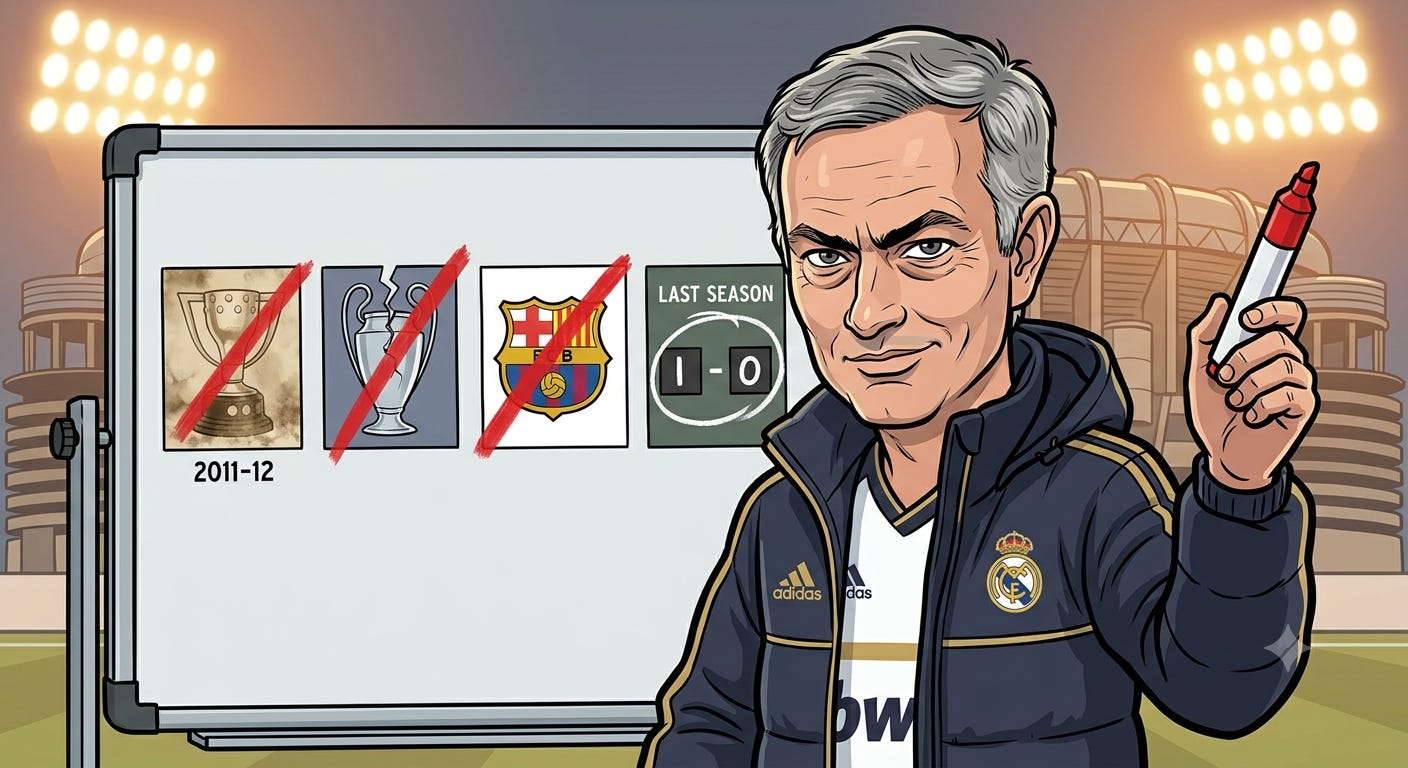
What’s the right reference class?
Madridistas set expectations against three reference classes.
1. Mourinho’s last successful season at Real Madrid (2011-12)
The most memorable season that José Mourinho had at Real Madrid was in 2011-12. The club won La Liga claiming a 100 points and scoring 121 goals. It failed to reach the Champions League final via penalties. It is natural for a fan to want that back. But, unfortunately, it’s an invalid reference class, one that is based on salience—wherein the most memorable (or generally the most cognitively available) class is used for comparison instead of the most causally similar one. A lot has changed in the past 15 years: Ronaldo, Guardiola’s Barcelona, and Bayern have been replaced by Mbappé, Flick’s Barcelona, and PSG. Mourinho himself hasn’t managed or won any major trophy at a top European club for a few years now.
2. Real Madrid’s last trophy-laden season (2023-24)
So, how about a more recent benchmark like the 2024 Champions League and La Liga winning team? Can this team emulate that one? It still has most of the stars from two years ago and has since added a whole host of stars including Mbappé, Trent, Diomandé, Bernardo, Cucurella, Dumfries, Konate, and Carlos Espí, a more agile Joselu.
Unfortunately, this reference class fails too, this time on the illusion of continuity where shared personnel gets mistaken for shared circumstances. One of the primary reasons for Madrid’s agony over the past couple of seasons has been the missing Connector. That has not been solved yet and a solution isn’t imminent either. And even if Madrid signs one now, it’d take the player some time to integrate into the squad.
3. Real Madrid’s last season (2025-26)
This is the valid reference class. The best way to forecast what Madrid can achieve in the upcoming season is by seeing how much it has improved over last season from the standpoint of personnel and performance.
The squad has clearly been upgraded in several positions:
Bernardo Silva over a jaded Dani Ceballos
Ibrahima Konate over an aging David Alaba
Marc Cucurella over a mediocre Fran Garcia
Yan Diomandé over a raw Franco Mastantuono
Denzel Dumfries over an aging Dani Carvajal
But the questions below remain:
Who will play Connector? With the non-signing of Rodri, and the signing of Diomandé, Madrid is now left with, not three, but four Salesmen and no Connector.
Can Valverde and Tchouameni co-exist? If this is the preferred double-pivot, can they play together again?
Where will Güler, who’s had a stellar pre-season so far, play?
Carreras, Huijsen, Rudiger, and Konate2 are all coming off a terrible season. Is their regression a dip or is it permanent? What role will Joan Martinez, who looked great in the friendlies, play?
Endrick confirmed he’s staying at least until January. What role will he play given Espí has signed?
It is easy to form an Inside View3 here. The defense has been fortified. Mourinho will (magically) mold one of Valverde, Güler, or Bernardo into playing Connector, complementing Tchouameni or Camavinga in the double pivot, and supply the four Salesmen: Bellingham, Diomandé, Mbappé, and Vinicius, challenging Barcelona for La Liga and PSG for the Champions League. This is optimism bias and it requires a combination of a lot going right for Real Madrid and a lot of going wrong for its competitors to work.
Instead, try taking the more accurate Outside View4. All these unknown unknowns cannot be brushed under the “Mourinho will solve it” carpet. Carlo Ancelotti, Xabi Alonso, and Alvaro Arbeloa—all individually brilliant managers—collectively failed. Mourinho needs time to resolve these uncertainties, and patience is not the club hierarchy’s virtue.
(Realistic) Expectations for this upcoming season
So, what should fans realistically expect from Real Madrid?
Identify a spine and back it: This is the Connector problem, but amplified. Real Madrid has a wobbly spine5 on top of missing the Connector. Barring Thibaut Courtois and Kylian Mbappé, the identity of the rest of the spine is still uncertain. Finding that identity and giving that spine the time to brew will set Real Madrid up for years to come.
Be more competitive in big games: Last year’s failures against Atletico, Barcelona, Liverpool, and Bayern Munich were telling. La Liga effectively gets decided by how well the top 3 do in their games with each other. Champions League fate is decided by how a team does against the likes of Arsenal, Bayern Munich, or Paris Saint-Germain. Madrid’s progress will be rated based on how competitive the team is in the biggest games.
Less drama: Last season was fraught with drama—mostly involving Vinicius, Mbappé, Valverde, Tchouameni, Rudiger, and Carreras. This kind of drama has not happened at Madrid for several years now. Mourinho has the habit of bringing the spotlight on himself so that it stays away from the players. Madrid needs that from the manager more than ever.
I want a trophy too: Mourinho after all won the Copa del Rey in his first season in his previous stint. But wishing for a repeat of that feat is salient and would be an invalid reference class. That said, if this team shows me that it has an identity, can stick together, compete in big games, and plays the same brand of scintillating football as it did that evening against Ajax on September 27, 2011, then it will be a season to remember and my reference class for the next.
Reference Class Forecasting as a three-step forecasting method was coined by Flyvbjerg (2006). Its roots trace back to “Planning Fallacy” (Kahneman & Tversky, 1979), and “Inside View vs. Outside View” (Kahneman & Lovallo, 1993).
This is when you focus on the specific case, build a mental model of how it will unfold, and forecast by extrapolating that model forward — this task, then that one, allowing for the obstacles you can currently foresee. This is how essentially everyone naturally plans, and it’s not stupid — it uses all the detail you actually have about your situation.
This is where you deliberately set the specifics aside, treat the case as one member of a class of similar cases, and forecast using how that class has actually performed, not how this instance is supposed to go.
At Liverpool mostly, but also with France at the World Cup.
Goalkeeper → central defense → central midfield → center forward