


On June 3, 2024, two days after winning its 15th Champions League title, Real Madrid announced the highly anticipated signing of Kylian Mbappé. The French world champion and arguably the most talented footballer on the planet arrived on a free transfer from PSG. This was yet another massive coup for the inimitable Florentino Perez. And in the eyes of Madridistas, Real Madrid had just won football.
Now, two years later, the tables have turned. PSG has since claimed back-to-back Champions League titles with prolific attacking football, while Madrid is left with a staggering surplus of talent and a glaring deficit of major silverware.
How is that possible? Isn’t 1 + 1 = 2?
In football math, it clearly isn’t.
The Tipping Point
In his book, The Tipping Point, Malcolm Gladwell theorizes that social epidemics are driven by distinct, underlying rules. Two of these are vital to understanding modern squad building:
The Law of the Few: A tiny fraction of people do the vast amount of work in spreading an epidemic. These exceptional individuals fall into three profiles:
Mavens: People who thrive on knowledge accumulation and are intrinsically motivated to share the raw message.
Connectors: People who possess an unusually large network spanning multiple circles, valuing the bridges that help information spread.
Salesmen: People who can persuade, often through innate, non-verbal abilities, compelling others to believe the message.
The Power of Context: The circumstances and spaces we inhabit dictate our actions far more than our intrinsic character does. Environment is everything.
Real Madrid’s plight since signing Mbappé becomes infinitely more explainable when we look at the pitch through this framework.
Applying the Framework
A football club is, in many ways, a microcosm of a complex adaptive system. It thrives on the structural harmony of individuals. To understand why Madrid failed to meet expectations over the past two seasons, we must look at its ecosystem through Gladwell’s Law of the Few and Power of Context.
Take any successful team at its peak in football history, and you will find a delicate balance of Mavens, Connectors, and Salesmen. In this context, Mavens are the managers who architect the raw tactical ideas (think Pep Guardiola or Sir Alex Ferguson). Connectors are the midfield generals who orchestrate the geometry on the field (think Xavi or Roy Keane). Salesmen are the superstars who execute the extraordinary, persuading the players around them to elevate their level (think Lionel Messi or Eric Cantona).
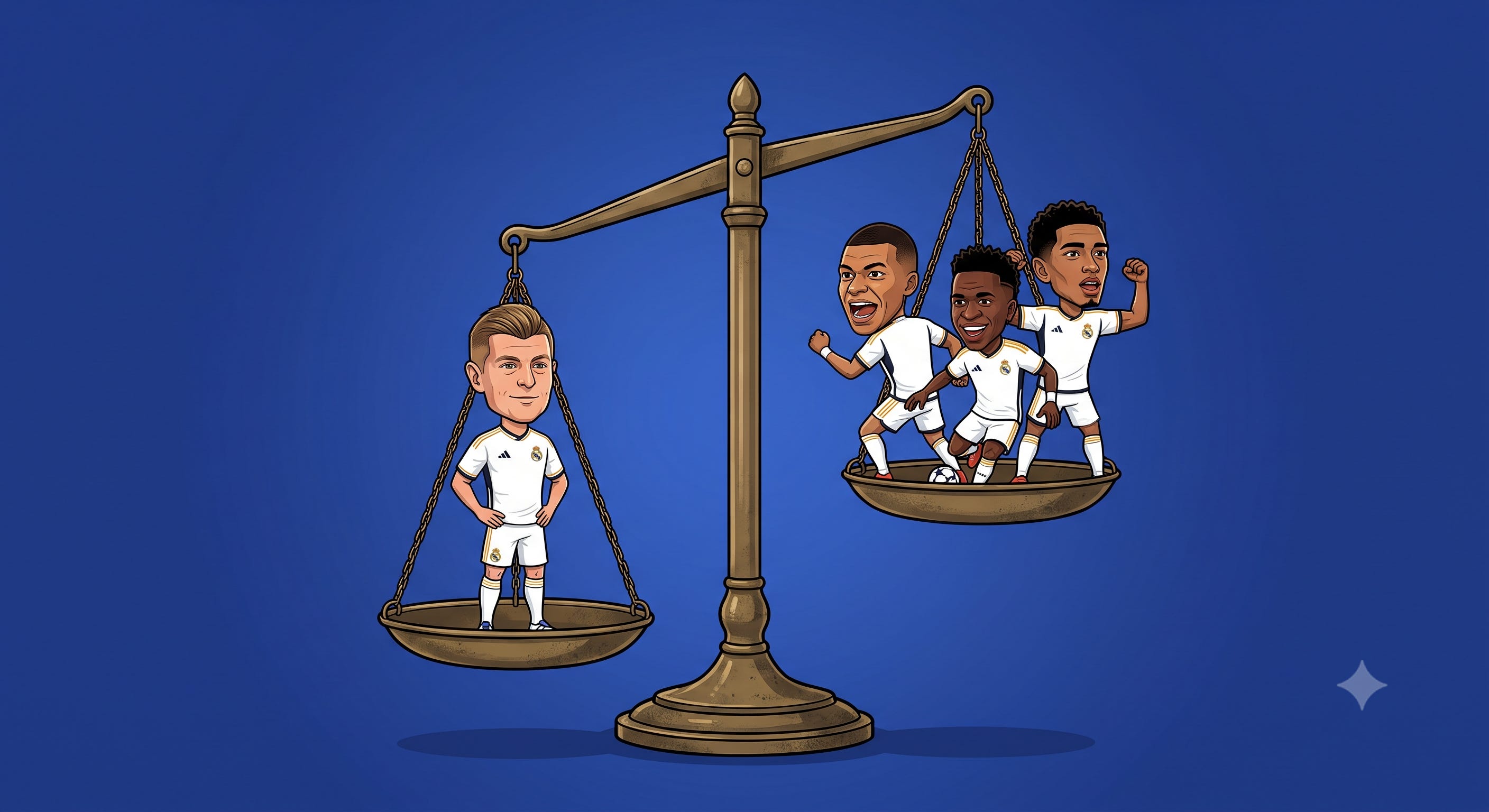
Not too long ago, under Carlo Ancelotti, Madrid struck this balance perfectly. In Toni Kroos, it had the ultimate Connector—a maestro with a supreme read on the game, a geometric understanding of the players around him, and the know-how to enable his Salesmen. He was set up to succeed by a balanced front line: Vinícius on the left, Benzema (and later Bellingham) in the middle, and Federico Valverde or Rodrygo on the right. With Luka Modrić by his side for occasions requiring more dynamism, Kroos orchestrated Madrid’s Champions League wins in 2022 and 2024.
Then, Toni Kroos retired. Real Madrid had lost its Connector.
Mbappé arrived that same summer. Suddenly, Real Madrid boasted three generational Salesmen: Vinícius, Bellingham, and Mbappé.
Vinícius excelled when given free rein on his favorite left wing, isolating defenders on the touchline and using his unpredictable footwork to either round the keeper or fire in from range. Bellingham was at his best when he had the room to make late, darting runs into the box, playing off complementary forwards who didn’t occupy his channels.
Mbappé was a hybrid of the two. He was magnetically attracted to the left flank but preferred to make darting, central runs behind the defense. This dynamic—Mbappé vying for the exact same space as Vinícius and the exact same runs as Bellingham—created a profoundly sub-optimal spatial environment.
What complicates this geometry even further is Madrid’s glaring weakness on the opposite flank. Until two years ago, this was solved by Valverde playing on the right wing. This balance across the front spread opposition defenses and created the necessary space for Vinícius and Bellingham to operate. However, that right-sided threat has completely faded, with Valverde taking a central midfield role to cover Modrić’s departure, combined with Rodrygo’s injuries and reluctance to hug the touchline.
Without a genuine right winger to stretch the pitch, Madrid has become entirely predictable. Because there is no threat on the right, opposing defenses simply tilt their compact blocks to the left, further suffocating three elite Salesmen who are already stepping on each other’s toes.
Looking Ahead
Real Madrid must solve its two big problems going into the new season.
Balance the Attack
Let’s assume for a second that Mourinho will continue to deploy his preferred 4-2-3-1 formation. To fix the Power of Context and draw defensive gravity away from Mbappé and Vinícius, the team desperately needs a reliable node on the right side of the pitch.
Theoretically speaking, there are several players in the current squad who can play on the right: Rodrygo, Brahim Diaz, Arda Güler, Endrick, and Franco Mastantuono. The latter three, notably, are left-footed. Then, there’s Valverde, who has done great every time he plays there, and Bernardo Silva, who has played there at Manchester City. And if push comes to shove, both Denzel Dumfries and Trent Alexander-Arnold can be genuine attacking threats too. On paper, plugging a player into this space sounds like an easy solve.
However, the reality of a complex system is different. Rodrygo is recovering from an ACL tear, Brahim has never elevated his status beyond a mildly effective substitute, Güler lacks the explosive pace, Endrick is still raw, and Mastantuono is just not ready for elite-tier European football. Valverde is said to prefer the midfield, and Bernardo Silva is certainly past the age where he can thrive as a wide Salesman in a fast-paced attack. And given the club prefers to rotate its natural fullbacks in the defensive line, it leaves management with no option but to look outward—which is clearly what they are doing, considering the strong links to Yan Diomandé.
Is Diomandé the solution to this broken geometry? It is hard to say. At 19, he is an explosive winger who primarily plays on the right but can also play on the left. He is a dribbler, making over four successful dribbles per 90 minutes—a Bundesliga record for last season. While he hasn’t been tested in a major competition for club or country, a recent profile by The Athletic suggests that he is similar to Vinícius but with a better disposition to help the defense.
Personally, I think Endrick deserves another chance to establish this right-sided node. He is 20, left-footed, explosive, and fundamentally shifts the team’s spatial context compared to Mbappé and Vinícius. Compared to Diomandé, statistically, his attacking in a similar league was marginally better at a much weaker team in Lyon despite having joined them only in January. And of course, the club could potentially save over €100 million in transfer budget.
Find a Connector
Stretching the pitch is irrelevant if the ball never arrives. If there’s one area on the field where Real Madrid has to spend money, it would be in midfield to fill the Connector void left by Toni Kroos.
There is no in-house replacement. Güler needs more time, and all the other midfielders currently in the ranks are of a different mold. There are no cheap alternatives. The market is inflated. And not finding a true Connector will very likely continue to hurt the club’s entire ecosystem.
Rodri could be the answer. He matches Kroos in his passing ability1 and has proven himself at the highest level. As a Spaniard, he is familiar with Madrid’s nuances and can be the leader that this disjointed team desperately needs. The downside is probably his age. Kroos came to Madrid at 24 and led the club to five Champions League titles in 10 seasons. While Rodri, aged 30, will not have the same long-term impact on this club, he would very likely have an immediate impact akin to what Mourinho is expected to create.
Madrid should not stop there. It must go out now and find a successor for Rodri, sign him up, and integrate him into the squad so that the next time the club loses its Connector, the replacement is ready to step up.
Conclusion
These are not entirely novel insights—the void left by Toni Kroos has been debated by pundits around the world. But Gladwell’s Tipping Point framework brings structural clarity to the madness Madridistas have witnessed on the pitch over the past two seasons. For the first time since Mbappé’s arrival, this transfer window feels like the club is finally close to solving the puzzle, leaving me with genuine hope and expectation. Here’s to the 16th. ¡Hala Madrid!
Although I’d have to see him do this against Barcelona, this against Juventus, and that against Bayern Munich to believe he’s just as good.